The 1.5 km Control Cable That Created an EMC-Enhanced Auxiliary Relay


How one “mystery trip” in a thermal power plant led to a new class of DC control relays.
When a Control Box Trips “For No Reason”
In 2003, a large thermal power plant ran into a problem no operations team wants to see: the local operation box on a high-voltage bay would trip seemingly at random.
No breaker failure, no misoperation recorded—just nuisance trips from the control box, often when nearby bays were being operated. The unit was safe, but the operators were not: every unexplained trip raised stress levels and eroded confidence in the control system.
Conventional checks showed nothing obviously wrong: wiring was correct, insulation was healthy, relays passed routine tests. On paper, the scheme was fine. In the field, it clearly was not.
The owner invited ODES engineers to site with portable disturbance recorders. That decision turned a confusing fault into a very concrete insight—and ultimately into what we now call an EMC-enhanced auxiliary relay for DC control circuits. Learn more about our relay and control solutions at www.odes-electric.com.

Root Cause: Long DC Control Cable as a Distributed Capacitor
The disturbance recorder made the problem visible. Each time a neighbouring bay was operated, the waveform showed a sharp, high-frequency transient on the DC control circuit feeding the local relay coil.

Three facts stood out during joint analysis with the plant’s engineers:
The DC control cable between the operation box and the control room was about 1.5 km long.
Electrically, that length is equivalent to a large distributed capacitance to earth and between cores.
Operating adjacent bays injected a fast transient into this long cable, briefly raising the relay coil voltage above its pickup threshold—even though the control switch for that bay was not operated.
In other words, ordinary auxiliary relays—designed for relatively short DC control runs—were being mis-operated by capacitive coupling and transient disturbance on an unusually long control cable.
This was not a simple “bad relay” problem; it was a system-level EMC issue in the DC control circuit.
Engineering the Solution: Redefining Pickup Criteria, Not Just the Part Number
Once the interference mechanism was clear, the question became: how do we design a relay that can still operate correctly, but is no longer “excited” by these transients?

Several levers were evaluated:
Increase pickup voltage
Add time delay
Filter the waveform
But each lever has trade-offs.
If the pickup threshold is set too high, the relay may fail to operate under legitimate low-voltage conditions (e.g. DC battery sag, long cable drop).
If it is set too low, transient immunity is poor and nuisance operation continues.
The final design combined three coordinated measures in the DC coil and associated electronics:
Pickup threshold at approximately 55% of nominal DC voltage (0.55 Un)
Anti-interference dropout / operate delay
Energy-based operating concept
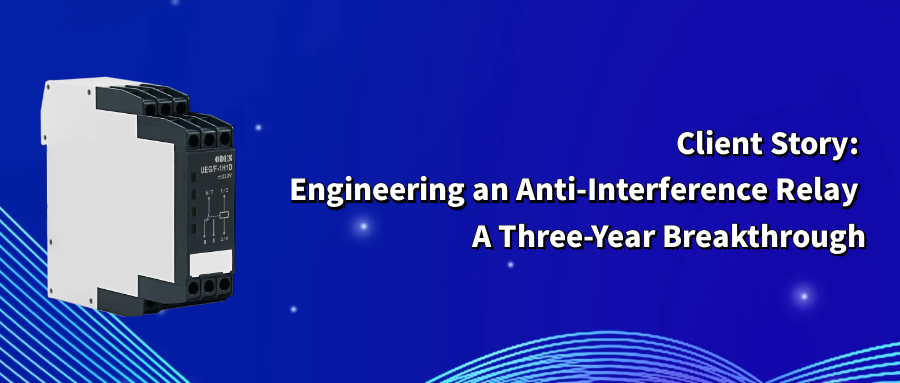
Taken together, these measures transform the relay from a simple voltage-triggered device into an EMC-enhanced auxiliary relay with defined pickup characteristics, dropout delay, and disturbance discrimination—tuned specifically for long-cable DC control circuits.
Three Years of Iteration: From 25 W Prototype to Standard Relay
The first generation of this EMC-enhanced auxiliary relay was intentionally conservative:
Oversized coil and internal circuitry
Power consumption around 25 W
Designed to prioritise nuisance-trip elimination over efficiency
In service, it achieved its main goal: over almost two years of operation, the unexplained trips disappeared. The plant’s operations team finally had a stable control box again.
Success brought the next question from the customer:
“Can you keep the interference immunity, but make it smaller and lower power?”
That request triggered nearly three more years of refinement:
Optimising magnetic circuit and coil design to reduce losses
Reducing internal power dissipation while maintaining pickup/reset ratios and time constants
Re-packaging the relay into a more compact, DIN-rail-friendly form factor
Expanding testing to more sites, including different DC system voltages and cable configurations
The end result was a new generation EMC-enhanced auxiliary relay that:
Maintains the original interference immunity
Reduces power consumption significantly
Fits more easily into dense control panels and retrofit projects
Achieves a field track record strong enough to be adopted as a standard solution in breaker trip and closing circuits

In 2007, ODES was among the first manufacturers to pass State Grid’s high-power EMC relay qualification tests, formally validating the performance of this relay family in utility DC systems.
Where EMC-Enhanced Auxiliary Relays Are Used Today
Over time, this relay did not stay confined to a single plant. It has become a standard building block in applications such as:
High-voltage circuit breaker trip and close circuits
Remote control boxes with long DC cables
Harsh EMC environments
By treating interference resilience as an integral coil characteristic rather than an afterthought, the relay helps convert “mysterious trips” into stable, predictable control circuit behaviour.
Lessons Learned: Craftsmanship Applied to a Single Alarm
Looking back, several engineering lessons stand out from this customer story:
Start from real disturbance data, not assumptions. The breakthrough came from capturing waveforms in the field and recognising the role of distributed cable capacitance.
Treat EMC as a system property, not just a component label. The long DC cable, earthing scheme and relay characteristics all interacted; changing only one element without understanding the system would not have been enough.
Turn one site’s problem into a reusable solution. Instead of a one-off fix, ODES invested in a full product redesign and type testing, so the same solution could be applied across many plants.
From a single nuisance trip in one thermal power plant, the industry gained a repeatable design pattern for EMC-enhanced auxiliary relays in DC control circuits.
Conclusion: From Nuisance Trip to Standard DC Control Building Block
The story of this EMC-enhanced auxiliary relay can be summarised in one sentence:
One 1.5 km control cable exposed a gap in conventional relays—and closed it for the entire fleet.
By analysing real interference mechanisms, redefining pickup and delay logic, and iterating design over several years, ODES turned a vague problem (“random trips”) into a precise, engineered solution with clear pickup, reset and disturbance immunity characteristics.
Today, these relays serve as standard DC control circuit elements in breaker trip/close circuits and long-distance control boxes, helping owners reduce nuisance tripping and increase confidence in their operation panels.
If you are facing nuisance operation in DC control circuits or planning new panels with long control cable runs, ODES can help you consult on EMC-enhanced auxiliary relay application, request typical settings and wiring diagrams, and learn how to standardise these relays as a DC control building block across your sites.
To contact our engineering team for technical support or sample evaluation, please write to:
You can also learn more about ODES relay, supervision and control solutions at https://www.odes-electric.com/sales-page

#auxiliaryrelay #EMC #nuisancetrip #controlcircuit #DCsystem #powerplant #substationautomation #longcable #pickupthreshold #IECstandards #gridreliability #engineeringstory #ODES


Comments