The RS485 Hub Built for Smart Substations — Why the ODES MSCR900 Series Is More Stable, More Efficient, and Easier to Maintain


As digital field instruments proliferate in smart substations—SF₆ density transmitters, arrester leakage monitors, oil temperature/level gauges—RS485 has become the backbone of data collection for GIS/AIS gas-density and auxiliary equipment monitoring. For more information on ODES communication and digital-instrument solutions, visit www.odes-electric.com.

But with more instruments come new challenges: More meters → longer cable runs → mixed series/parallel topologies → higher EMC exposure → more difficult maintenance.
The ODES MSCR900 Series RS485 Hub was designed specifically to fix these real-world issues: making RS485 stable over distance, resilient under interference, and easy to maintain in complex substations.

1. True Multi-Branch Isolation — Star Topology Done Right
The MSCR900 family includes:
MSCR902 – 1 master + 4 isolated branches
MSCR903 – 1 master + 8 isolated branches
Each branch is electrically isolated from the others. This architecture replaces fragile daisy-chains with a true star topology, allowing each sensor cluster (e.g., SF₆ gas chambers, oil-temperature groups, arrester bays) to run independently.
Engineering benefits
A fault on one branch does not drag down the rest of the network.
Maintenance becomes faster—technicians can isolate a miswired or failed device instantly.
Long-term stability improves because signals no longer influence each other through shared lines.
This is exactly the wiring model smart-substation guidelines envision but typical RS485 hardware cannot support.
2. A “Rock-Solid” RS485 Physical Layer for Harsh Substation Environments
The MSCR900 series is built on a hardened RS485 layer conforming to TIA/EIA-485-A, with transparent half-duplex forwarding and automatic TX/RX switching.
Key communication capabilities
300 bps to 115.2 kbps adjustable baudrate
Stable at both high and ultra-low rates
Clean signal shaping for long cable runs
RX/TX/error LEDs on every branch for visual troubleshooting
This makes the MSCR900 compatible with all major digital instrument brands and all unified protocols used in smart-substation deployments.
3. Channel Isolation and EMC Hardening — The Performance That Actually Matters
Every branch is galvanically isolated from the master station with typical withstand capability of 2.5 kVDC. This protects against:
Lightning surge
Fast transient disturbance
Ground potential rise
Inter-branch fault propagation
Each branch carries PWR / RX / TX / ERR indicators so technicians can diagnose wiring, timing, or device problems at a glance—no laptop required.
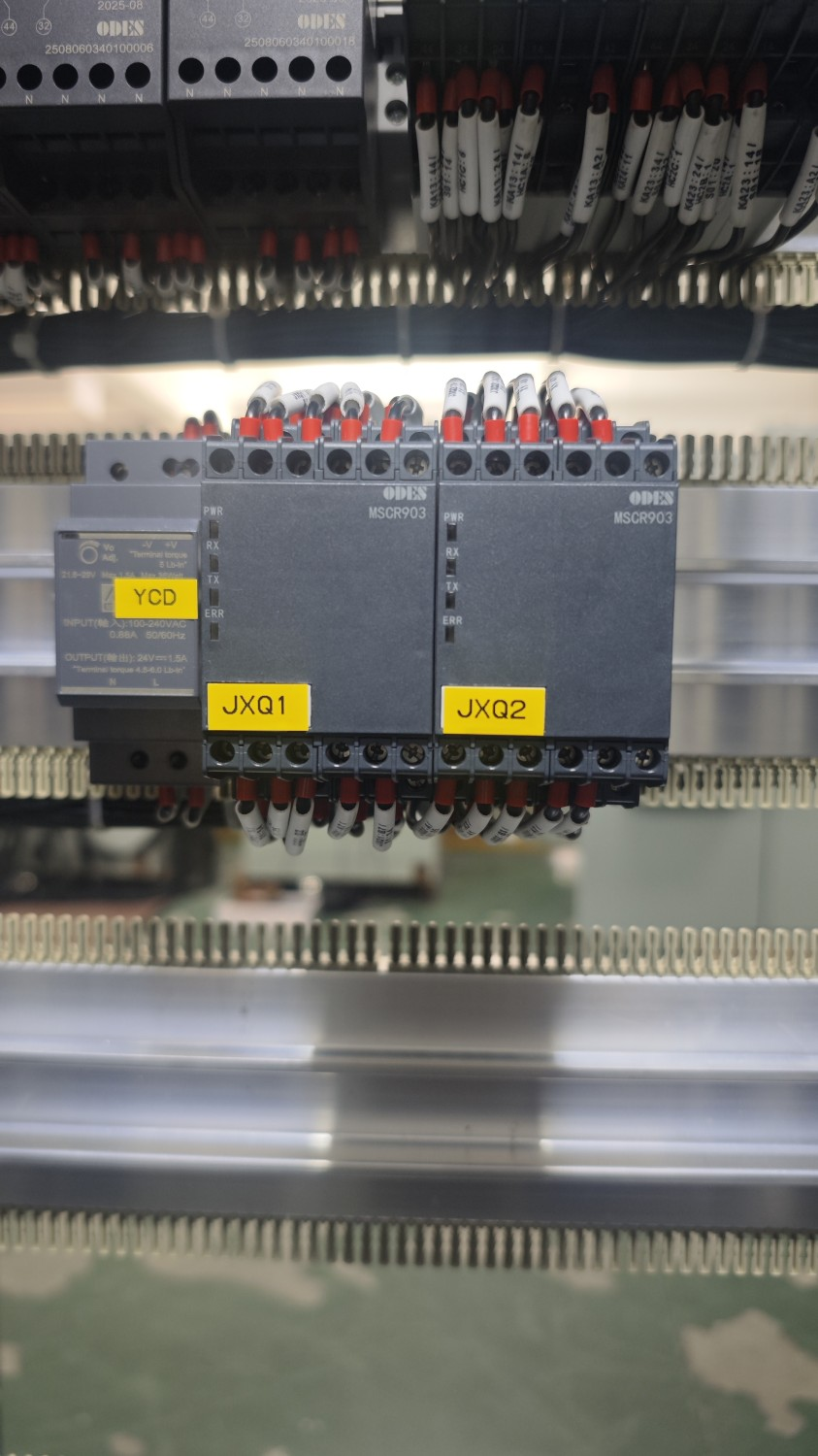
4. Installation and Retrofit Friendly — Designed for Field Reality
Compact DIN-rail form factor
MSCR902: 22.5 mm width
MSCR903: 45 mm width
Height: 88 ± 0.5 mm
These dimensions fit inside local GIS cabinets, field junction boxes, and retrofit enclosures without requiring layout redesign. For old stations with limited space, this is a major advantage.
Ideal for both new and legacy stations
The hub is equally effective in:
New digital-instrument installations
Mixed-vendor monitoring retrofits
Breaking long daisy-chains into cleaner star partitions
Expansions where only part of the system is being upgraded
5. Why Utilities Choose the MSCR900
Engineering aligned with national smart-substation standards
The hub’s parameters, interfaces, and RS485 characteristics align with the mandatory requirements for digital instrument remote transmission, ensuring compatibility with modern station-end gateways.
Faults contained to their smallest unit
A shorted or noisy branch remains isolated—no more “one device takes down the entire line.”
Visual maintenance
LED indicators make branch-level diagnosis almost instantaneous, dramatically reducing time spent on wiring checks or protocol timing issues.
Retrofit-friendly
The hub’s small footprint and unified design ensure older cabinets can adopt modern cabling practices without crowding or rewiring the entire substation.

Recommended Application Architectures
1. GIS Gas-Density Monitoring
Use MSCR903 to collect sensors by gas chamber or bay. Combine shielded twisted pairs with single-end grounding; use layered shielding for the main trunk vs. branches.
2. Mixed Oil-Temperature / Oil-Level / Arrester Leakage Monitoring
Separate high-frequency and low-frequency sensors into different branches. Place different vendors’ instruments on separate branches to avoid timing interference.
3. Legacy Station Retrofit
Break long daisy chains into 2–4 star partitions, each isolated. This reduces cross-talk, removes the “single-point failure” problem, and makes maintenance intuitive.
Conclusion
Digital meters are here to stay—and RS485 remains the most reliable way to gather their data. The ODES MSCR900 Series RS485 Hub gives smart substations what they truly need: stability, maintainability, and engineering discipline in an increasingly complex field environment.
If you need RS485 that is stable over long distances, resistant to interference, and easy to troubleshoot, MSCR900 is the tool built exactly for that job.
Need wiring diagrams, star-topology recommendations, or a selection sheet for MSCR902/903? Send your station type, meter list, and branch layout requirements for a tailored access plan and shielding/grounding guide.
Contact: 📩 tonyzhang@odes-electric.com

#RS485Hub #SmartSubstation #DigitalInstruments #SF6Monitoring #EMCDesign #SurgeProtection #SecondarySystems #SubstationAutomation #UtilitySolutions #ReliabilityEngineering #IndustrialAutomation #GridModernization #PowerSystems #ODES


Comments