Top 10 Wind Farms in the World: How Wind Power Is Becoming a Mainstream Energy Source

Over the past decade, the most important change in the wind power industry has not only been larger turbines or longer blades. More importantly, wind farms themselves are evolving from individual renewable projects into system-level power infrastructure.
A modern large-scale wind farm is no longer just a group of turbines standing in the wind. Behind it are high-voltage transmission, offshore substations, reactive power compensation, protection systems, remote operation, power forecasting, and grid dispatching.
Below is a professional review of ten of the world’s most representative large-scale wind farms and wind power bases, ranked mainly by publicly available installed capacity and industry influence.

No.1 Jiuquan Wind Power Base, China
Location: Jiuquan, Guazhou and Yumen, Gansu Province, ChinaType: Onshore wind power baseScale: Approximately 10 GW installed, with long-term planning at around 20 GW
The Jiuquan Wind Power Base is widely regarded as one of the largest wind power bases in the world. Located in the Gobi desert region of northwest China, it benefits from abundant wind resources and favorable land conditions for large-scale development.
Its significance goes far beyond installed capacity. Jiuquan proves a key principle of modern wind power development: large-scale wind generation must be planned together with long-distance transmission, grid absorption capacity, and regional dispatching.
In other words, Jiuquan is not just a wind farm. It represents the transformation of renewable energy from project-level construction to system-level engineering.

No.2 Hami Wind Power Base, China
Location: Hami, Xinjiang, ChinaType: Onshore wind power baseScale: A ten-million-kilowatt-level wind power base
Hami is one of China’s most important renewable energy bases in the northwest region. It has rich wind resources, vast land availability, and strong potential for integrated wind-solar-storage development.
The key advantage of Hami lies in the combination of resources, transmission channels, and industrial support. Wind power here is not developed as an isolated project. It is closely connected with ultra-high-voltage power transmission, solar power, energy storage, coal-fired flexibility support, and local equipment manufacturing.
This model may become increasingly important for future large-scale renewable energy bases around the world.

No.3 Dogger Bank Wind Farm, United Kingdom
Location: North Sea, around 130–190 km off the northeast coast of EnglandType: Offshore wind farmScale: 3.6 GW across three phases
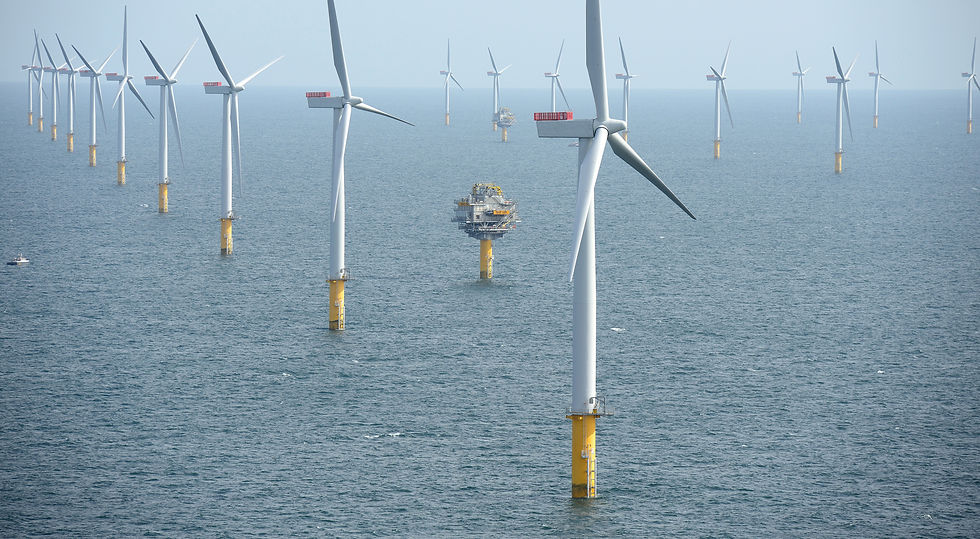
Dogger Bank is one of the most iconic offshore wind projects in the world. It is being developed in three phases: Dogger Bank A, B, and C, each with a capacity of 1.2 GW.
Its importance lies in showing where offshore wind is heading: deeper waters, larger turbines, longer offshore distances, and much larger project scale.
The engineering requirements are extremely demanding. Long-distance submarine cables, offshore substations, heavy-lift installation vessels, weather windows, digital monitoring, and remote maintenance all become critical factors. Dogger Bank demonstrates the upper limit of current European offshore wind engineering capability.
No.4 Jaisalmer Wind Park, India
Location: Jaisalmer, Rajasthan, IndiaType: Onshore wind farmScale: More than 1.6 GW according to public industry sources
Jaisalmer Wind Park is located near the desert region of western India, where wind resources are relatively stable and suitable for long-term development.
Its advantage lies in phased, multi-owner, multi-turbine development. It is less like a single one-time project and more like a long-term renewable energy zone that continues to expand and evolve.
For India, Jaisalmer is important because it helped build local wind power experience, engineering capability, operational expertise, and supply chain confidence.

No.5 Alta Wind Energy Center, United States
Location: Kern County, California, United StatesType: Onshore wind farmScale: Approximately 1.55 GW
Alta Wind Energy Center is one of the most representative onshore wind projects in the United States. It is located in the Tehachapi Pass area of California, one of the country’s most famous wind resource regions.
Its strength is not only wind quality, but also market access. Alta is close to California’s large electricity demand centers and has historically benefited from long-term power purchase agreements.
This project highlights a key rule of wind power investment: a good wind farm is not only about wind speed. Grid connection, electricity demand, power purchase agreements, and regulatory support are equally important.

No.6 Muppandal Wind Farm, India
Location: Kanyakumari district, Tamil Nadu, IndiaType: Onshore wind farmScale: Approximately 1.5 GW
Muppandal is one of India’s earliest and most influential large-scale wind power projects. Located in southern India, it benefits from strong wind conditions shaped by local terrain and seasonal wind patterns.
Its development history is long, with multiple owners and generations of turbines involved. This makes Muppandal a typical example of how developing markets can move from pilot wind projects to large-scale commercial deployment.
Its value lies not only in power generation, but also in the long-term development of wind power operations, maintenance capability, and local industry participation.

No.7 Kutch Wind Farm, India
Location: Kutch, Gujarat, IndiaType: Onshore wind farmScale: More than 1.4 GW according to public industry sources
Kutch is another major wind power cluster in western India. Located near the coast, it has strong wind development potential and has become an important region for wind project development and equipment manufacturing.
The core advantage of Kutch is industrial coordination. Large wind projects require not only turbines, but also blades, towers, nacelles, electrical systems, construction capacity, service teams, and spare parts support.
Kutch shows how a large wind power region can also help build a regional renewable energy supply chain.

No.8 Hornsea 2, United Kingdom
Location: North Sea, off the Yorkshire coast, United KingdomType: Offshore wind farmScale: Approximately 1.3 GW
Hornsea 2 is one of the landmark projects in the global offshore wind industry. With 165 offshore turbines, it represents the move of offshore wind from demonstration-scale projects to large-scale mainstream power generation.
Its engineering challenges are concentrated in offshore construction, harsh marine conditions, offshore substations, subsea cable systems, and long-term operation and maintenance.
Hornsea 2 proves that offshore wind can become a major source of electricity in developed power markets, especially when strong policy support, grid planning, and offshore engineering capability are combined.

No.9 Seagreen Offshore Wind Farm, United Kingdom
Location: North Sea, off the Angus coast of ScotlandType: Offshore wind farmScale: Approximately 1.075 GW
Seagreen is one of Scotland’s largest offshore wind farms and a representative project for deeper-water fixed-bottom offshore wind.
Compared with many nearshore projects, Seagreen faces more complex engineering conditions, including deeper waters, harsher marine environments, more demanding foundation design, and tighter maintenance windows.
Its value lies in demonstrating how offshore wind can move into more challenging sea areas while maintaining commercial viability and reliable power output.

No.10 Western Spirit Wind, United States
Location: Guadalupe, Lincoln, and Torrance counties, New Mexico, United StatesType: Onshore wind projectScale: Approximately 1.05 GW
Western Spirit Wind is one of the largest single-phase wind power projects in North America. It consists of several wind projects developed together with dedicated transmission infrastructure.
Its biggest advantage is integrated planning between generation and transmission.
Many high-quality wind resource areas are located far away from major load centers. Without transmission capacity, wind resources cannot be effectively converted into marketable electricity. Western Spirit shows why future wind development must consider wind farms and transmission networks as one integrated system.

Final Thoughts: Wind Power Requires More Than Turbines
Wind power is different from traditional thermal or hydropower generation. Its output is variable, weather-dependent, and geographically dispersed. Wind speed fluctuations lead to power fluctuations. Offshore wind farms also face salt mist, humidity, vibration, long-distance subsea cables, and high maintenance costs. Large onshore wind bases often need long-distance transmission, reactive power support, voltage stability, and coordinated grid dispatching.
That means the reliability of a wind farm does not depend only on the turbine itself. It also depends on substations, collection lines, protection circuits, control power supplies, signal isolation, alarm systems, and safe maintenance testing.
This is where ODES related products can provide practical value. In wind farm substations, transformer control cabinets, protection panels, and maintenance testing scenarios, ODES products such as Testblocks, measuring and monitoring relays, auxiliary relays, trip circuit supervision modules, signal isolation modules, audible and visual alarm devices, enclosure climate control products, and DIN-rail power supplies can support secondary circuit testing, status monitoring, fault alarming, signal conversion, and maintenance safety.
The future of wind power is not simply about installing more turbines. It is about building power systems that are more reliable, easier to maintain, and better integrated into the grid. In this process, the often-overlooked control and protection components will become an important foundation for long-term wind farm reliability.


Comments