2027 AI Inference Is Getting Cheaper: The Power Infrastructure Behind It Is Getting More Complex

What DeepSeek's DeepInfer reveals about the next opportunity in electrical protection and control.
The AI industry is celebrating another breakthrough in inference efficiency. But for power system engineers, a different question deserves attention:
As AI inference becomes more accessible and deployment moves closer to users, is the electrical infrastructure ready to support it?
DeepSeek's release of DeepInfer in October 2026 provides an interesting starting point. While most discussions focus on GPU utilization, inference costs and software architecture, the development also raises important questions about the physical infrastructure required to support increasingly diverse AI deployments.
The opportunity extends beyond constructing more data centers. It also involves making power distribution, protection and control systems more reliable, adaptable and easier to integrate.
For companies working in electrical secondary systems, this may represent an important emerging market.

1. DeepInfer Changes the Economics of AI Infrastructure, but Not Overnight
DeepInfer is the high-performance inference framework supporting DeepSeek's large-scale production services.
According to DeepSeek's official technical documentation, a single production cluster currently processes approximately 155 trillion tokens per day, with reported revenue of $38 per GPU-hour at off-peak pricing. Its architecture also uses a distributed KV Cache storage system with approximately 100 PiB of SSD capacity, allowing previously processed context to be reused across requests.
These figures illustrate how far inference optimization has progressed. Better scheduling, load balancing and cache reuse can improve computing efficiency, helping operators serve more requests without increasing computing resources proportionally.
There is, however, an important distinction between demonstrating exceptional performance and making large-scale infrastructure immediately affordable to everyone.
The open-source DeepInfer release does not yet include every component required for a complete production inference service. Its KV Cache management and some load-balancing capabilities remain closely integrated with DeepSeek's internal infrastructure. DeepSeek also identifies approximately 128 GPUs as the smallest efficient production deployment unit in its reference architecture.
Therefore, open-source software alone does not eliminate the capital, operational or engineering requirements of private AI infrastructure.
What it does provide is greater technical visibility and a foundation for further optimization.
Over time, developments like these may expand the range of organizations capable of evaluating their own inference infrastructure, whether through private clouds, regional data centers or hybrid deployments.
This distinction matters when assessing the broader market opportunity.
Source: DeepSeek, DeepInfer official repository and Inference Deployment Q&A (October 2026).

2. AI Deployment Is Becoming More Geographically Diverse
For years, the data center industry has been shaped by hyperscale cloud infrastructure. Large facilities benefit from economies of scale, centralized operations and substantial investment in power and cooling systems.
That model will remain essential. However, not every inference workload has the same requirements as model training.
Real-time industrial applications, enterprise AI agents, healthcare systems and latency-sensitive services may benefit from computing resources located closer to users or sensitive business data.
S&P Global's 2026 Trends in Data Center Services & Infrastructure identifies edge AI inference as an increasingly important development. It highlights latency, security, data sovereignty and infrastructure economics as factors influencing where inference workloads are deployed.
CBRE's North America Data Center Trends H2 2025 reaches a similar conclusion, observing that inference is increasing the need for regional and distributed data center capacity.
The commercial motivation is also changing.
An IBM Institute for Business Value study published in June 2026 surveyed 1,000 senior executives across 16 countries and found that 68% considered meeting data residency and sovereignty requirements across geographies challenging.
This does not mean every organization will build its own data center. Public cloud platforms, colocation providers, sovereign clouds and hybrid infrastructure will continue to coexist.
Instead, it suggests a more diversified deployment landscape, with computing resources distributed across different facility sizes, locations and ownership models.
For electrical infrastructure providers, this could create opportunities that differ significantly from those associated with traditional hyperscale projects.
A regional inference facility, enterprise computing center or AI-enabled industrial site may need to integrate new computing loads into an existing electrical distribution system rather than build an entirely new power infrastructure from the ground up.
And that introduces a different set of engineering constraints.

3. When Computing Loads Change, Protection Engineering Must Respond
The growing energy requirements of AI are already attracting attention from the international energy industry.
In April 2026, the International Energy Agency reported that global data center electricity demand had increased by 17% in 2025. Its updated analysis projected that worldwide data center electricity consumption could double by 2030.
IEA Executive Director Fatih Birol summarized the relationship with a memorable observation:
"There is no AI without energy."
Yet the engineering challenge is not simply how much electricity AI requires. It is also how that demand behaves.
Traditional electrical infrastructure is designed around defined operating conditions, equipment characteristics and expected changes in load.
AI-oriented computing environments can introduce highly dynamic electrical demand, particularly when large GPU clusters alternate between intensive computation and synchronization.
Eaton's technical white paper on AI data center pulse loads describes examples where power demand fluctuates between 50% and 100% of its maximum level over short intervals. Without appropriate mitigation, such fluctuations can contribute to voltage variations and disturbances affecting upstream electrical equipment.
These observations are not theoretical concerns alone.
In its July 2025 report Characteristics and Risks of Emerging Large Loads, the North American Electric Reliability Corporation (NERC) documented an incident involving approximately 1,500 MW of voltage-sensitive load reduction, primarily associated with data centers and other power-electronic loads transferring to backup supplies following a transmission disturbance.
Importantly, the event did not simply involve conventional circuit breaker tripping. It demonstrated how the behavior of large electrical loads and their internal control systems can affect wider power-system stability.
This distinction has direct implications for protection engineering.
A reliable AI facility requires coordination across several layers: grid connection, voltage regulation, UPS and energy storage, backup power, protection devices, control circuits and operational monitoring.
Protective relays cannot eliminate every voltage disturbance, and faster tripping is not automatically better protection.
Correct protection depends on selectivity, fault-clearing requirements, equipment withstand capability, ride-through coordination and the interaction between upstream and downstream systems.
A protection scheme must isolate genuine faults while avoiding unnecessary interruption during disturbances that the facility is designed to withstand.
For existing industrial sites and regional facilities, achieving this balance can be particularly challenging because the electrical system may not have been designed around modern AI computing loads.
This is where application-specific secondary protection and control engineering becomes increasingly relevant.

4. The Market Opportunity Is Not Just More Equipment. It Is Better Integration.
The response of major electrical technology companies already provides evidence that AI infrastructure is becoming a strategic market for power distribution and automation.
In September 2026, Schneider Electric introduced its software-defined medium-voltage switchgear architecture for AI-ready data centers, with a pilot installation at Equinix.
According to Schneider Electric, its approach can accelerate ordering, manufacturing and commissioning by replacing portions of customized hardware engineering with standardized, software-configurable functionality.
The company reported up to three times faster ordering and manufacturing and up to twice as fast commissioning in its comparisons with conventional engineered-to-order systems.
These are vendor-reported results for a defined comparison, not universal performance guarantees. Nevertheless, they show where engineering priorities are moving: standardization, shorter commissioning cycles, digital integration and operational adaptability.
Schneider Electric CEO Olivier Blum expressed the underlying principle in a September 2026 industry commentary:
"AI may be digital. But it runs on the physical world."
For secondary equipment manufacturers, this observation is particularly relevant.
As power systems become more automated and digitally coordinated, reliability still depends on physical interfaces that must operate correctly under actual electrical conditions.
The correct operation of a trip circuit, the dependable indication of equipment status, the coordination of electrical interlocking and the reliability of auxiliary control power remain essential.
These functions may represent only a small portion of total data center investment, but they can have significant consequences for commissioning, fault management and operational continuity.
This is not necessarily a market defined by one standardized product installed in enormous quantities.
It may also be a market in which application suitability, interface reliability and engineering verification become decisive purchasing criteria.

5. Where ODES Sees an Opportunity in the AI Infrastructure Value Chain
At ODES, our expertise lies in power system secondary circuits, including protection, control, supervision and supporting electrical interfaces.
With more than two decades of experience in the development and manufacturing of protective and auxiliary relay products, we approach emerging applications from the perspective of system-level electrical requirements.
We do not see our role as replacing major medium-voltage equipment manufacturers or supplying complete data center power systems.
Instead, we see opportunities to work with OEMs, panel builders, system integrators and electrical engineering partners on the secondary functions that connect primary equipment, protection devices and control systems.
These may include dependable trip and lockout interfaces, auxiliary control and indication circuits, interlocking arrangements, control-power continuity and testable interfaces for commissioning and maintenance.
The precise configuration depends on the electrical architecture and the applicable project requirements. Not every conventional substation protection arrangement transfers directly to an AI data center.
That is why application engineering matters.
For an existing facility introducing new AI computing loads, the challenge may involve understanding how the current distribution system responds to load variations, how protection settings coordinate with backup-power systems, and how secondary circuits should behave during disturbances or switching operations.
In such projects, product quality alone is not sufficient. Design validation, functional testing, clear documentation and close cooperation with equipment manufacturers and engineering contractors are equally important.
The opportunity for ODES is to bring established secondary-circuit engineering experience into new computing-infrastructure applications, while developing and validating solutions for the specific operating conditions they present.
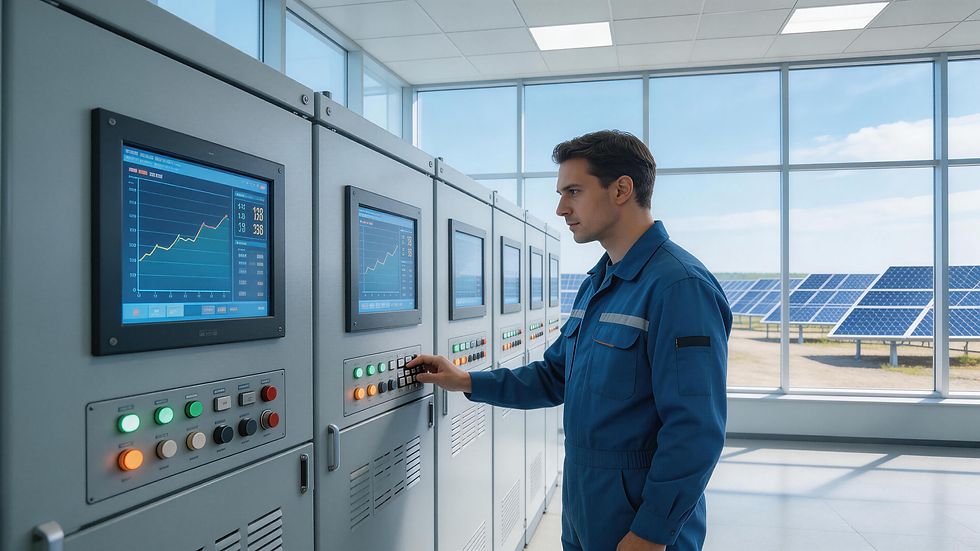
6. The Next AI Infrastructure Opportunity May Be Hidden in the Electrical Details
The global expansion of AI is creating demand for more computing capacity, but it is also changing the requirements placed on electrical infrastructure.
DeepInfer illustrates how inference technology continues to improve in efficiency and openness. Industry research suggests that the deployment of AI inference may become more geographically distributed as requirements for latency, data governance and operational control evolve.
At the same time, research from the IEA, NERC and electrical equipment manufacturers demonstrates that AI computing loads are introducing new challenges for power systems.
The resulting opportunity is not simply about increasing the number of protection relays sold.
It is about adapting electrical protection and control systems to increasingly diverse computing environments.
Some projects will require large, purpose-built substations and standardized power infrastructure. Others will require carefully engineered integration with existing distribution networks, backup systems and facility control architectures.
Both demand reliability. But they may require different approaches to achieving it.
The next phase of AI infrastructure development will not be determined by computing performance alone. It will also depend on the electrical systems capable of supporting that performance safely and continuously.
For power protection and secondary-system engineers, the AI infrastructure story is only beginning.
As AI inference expands beyond hyperscale campuses, which electrical reliability challenges do you expect to become the most important: power quality, protection coordination, backup-power integration or commissioning complexity?
We welcome perspectives from data center engineers, protection specialists, OEM partners and system integrators.
Sources and Further Reading
DeepSeek — DeepInfer: Official Repository and Deployment Q&A (2026)
https://github.com/deepseek-ai/DeepInfer
https://github.com/deepseek-ai/DeepInfer/blob/main/doc/inference_deployment_qa.md
International Energy Agency — Key Questions on Energy and AI, April 2026
S&P Global — 2026 Trends in Data Center Services & Infrastructure
CBRE — North America Data Center Trends H2 2025
https://www.cbre.com/insights/books/north-america-data-center-trends
IBM Institute for Business Value — The Calculus of AI Sovereignty (June 2026)
NERC — Characteristics and Risks of Emerging Large Loads (July 2025)
Eaton — Solving AI Data Center Power Pulse-Load Issues with Supercapacitors
Schneider Electric — Software-Defined Medium-Voltage Switchgear Announcement (September 2026)
https://www.se.com/ww/en/work/products/product-reveal/software-defined-medium-voltage-switchgear/
Olivier Blum, CEO of Schneider Electric — The Era of Intelligence Will Be Built on Electricity (September 2026)
Fatih Birol, IEA Executive Director — LinkedIn Commentary on AI and Data Center Energy Demand


Comments